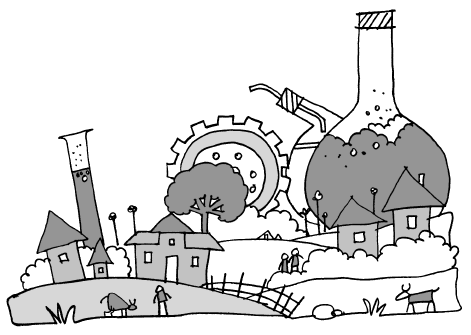
The People’s Science Movement in Kerala, spearheaded by the Kerala Sastra Sahitya Parishad (Science-Literature Society) is a purely voluntary movement which emerged through the activities of a group of scientists, science writers, teachers and social workers. It was started in 1962 as a forum for the popularisation of science among the people. Their activities included the publication of popular books, magazines, and reports, study classes among the rural people, adult literacy programmes, science clubs and contests for students, informal training programmes for technicians and artisans, programmes on health care and environment and action-oriented research. KSSP activists carried out these activities on a voluntary basis. All these activities were carried out on a voluntary basis by the activists. These initiatives have won the acceptance of the people, who are closely involved in several of the programmes. Such a process of interaction has enabled the Parishad to sharpen further its understanding of the social reality and thus carve out a role for itself in the lives of the people. |
Taken from
KP Kannan, A People’s Science Movement Development: Seeds of Change, Rome. 1981. p37. [R.Q12.17]. Mathew Zachariah and R Sooryamoorthy, Science for Social Revolution? Achievements and Dilemmas of a Development Movement: The Kerala Sastra Sahitya Parishad. Vistaar Publications, New Delhi. 1994. [B.Q70.Z60]. Some chapters
Ramachandra Guha, The Alternative Science Movement: An Interim Assessment.
Lokayan, Delhi. 6:3. 1988.
An assessment of the basic ideas of the anti-western science paradigm. One stream centered around the Patriotic and People’s Science and Technology and the other associated with Ashis Nandy, Claude Alvares and Shiv Visvanathan. |