In
the era of LPG (Liberalisation, Privitisation and Globalisation), all
eyes are on the NGO sector, for two diametrically opposing reasons.
On the one hand, the establishment is very critical of NGOs who have
played a liberating function, vis as vis the current regime, while on
the other, there is a clear promotion of a kind of NGO who will do
the role of the State in so far as it can deliver social services
expected of the state.
The
former is clearly demonstrated by the Eklavya experience with the
Madhya Pradesh government in the context of science education. Why
would a state government try to gag a programme which has been
responsible for developing a questioning method of scientific
enquiry, in its science teaching programme? If it has specific
problems with it, it could have taken the programme further. It is
also significant that this attempt to thwart a pioneering effort,
synchronizes with introduction of subjects like astronomy and Vedic
sciences in other areas.
The
other effort, is mainly aimed at a mainstay conventional delivery or
contractor status to NGOs, and other private actors. The argument is
that government schools are run by a corrupt bureaucracy, and
therefore this task needs to be handed over to more committed people.
They have suggested that Schools
could be privatized.
To
take care of the poorer students, there is also a proposal of an
“Education Voucher” system, which are given to parents by the
government, which they give to the private school who in turn get
their grant accordingly. It is hoped that this will ensure that the
school concerned will maintain its quality as a result.
There
are those who believe that the government schools should compete with
private schools for the Education vouchers. Rather than compete, it
is more likely that the government schools will be marginalised,
starved of funding and infrastructure, and we will see slow and
steady degeneration and neglect. Witness how many Municipal schools
in Mumbai have closed down and its premises used for housing offices
of the Municipality and a few NGOs. Further, in
the past such an open access to grants, have generally resulted in a
whole host of bogus and dubious institutions and educational
societies. In Tamil Nadu for instance, a large number of institutions
of engineering and higher education have come up, and have been
allotted large tracts of land.
Further
privatization is not likely to ensure better quality.
Past
history has shown how such ventures are slowly bogged down by tardy
curriculum, and hierarchical school inspection system, that they
loose all their original creativity, dedication, innovation, as well
as methodology, and standards.
Witness
how certain schools have been forced to take in more students. Or how
teachers and principal appointments and promotions are standardized
and regulated. More recently, the foundation courses at the
undergraduate level, which was mainly responsible for student
self-study on important civic and political issues have diluted,
ostensibly because of pressure from a teachers union.
Thus
the problem of quality government schools, and therefore of the
predominantly poorer sections of our society, can mainly by
addressing the bureaucratic and political interference in such
schools. Teachers need to be made more accountable.
Schools principals should be able to take academic decisions, and
the
local community and teachers should be actively involved in both
contributing to, and assessing the school.
The
government should concentrate on the output rather than the inputs,
which go into the education system.
IT
is not that non-governmental schools have not made a contribution to
Education. In fact denominational schools, particularly those run by
Christians have provided a kind of a benchmark of quality, or more
correctly commitment to the cause. Today we are also witnessing many
non-church run schools taking up names which start with Saint,
indicating the kind of school that parents can expect. Other
denominations like Aurobindo Ashram schools also see their role as
delivering top quality education at low costs. The Rishi Valley and
Krishnamurthy related schools also do long term work, setting high
standards of teaching as well as innovations, and ethic practices,
and liberating methodologies.
Nature
of NGO Interventions
Despite
these stellar examples, it must be noted that the most important
contribution of the NGO sector, in the field of education, has been
innovations, and development. More specifically the effort has been
to mainstream their learning into the general schooling system
particularly in Government schools. These are mainly in the areas of:
- Developing
curriculum materials
- Innovation in
teaching – learning processes
- Teacher Training and
- Sourcing Community
Support
Such
NGO Work can be broadly and non-exclusively grouped as:
- Language
Teaching including Communications
- Developing
Unconventional areas of Curriculum
like Health, Environmental education
- Efforts focusing
on specific subjects like
Mathematics and Science
- Whole School
Approach, and
- Accountability
and Local Community Involvement
- Advocacy on
broad approach to Education
1.
Language Teaching Including Communications.
Language
is closely related to culture and social communication. Local
Language is rooted in the oral traditions, and is essential for
creative and clear expression, as organizations like Alarippu have
demonstrated by using theatre, Literacy is linked to the more modern
functions which has to be learnt. And since it is a kind of a
gatekeeper to education, particular for first generation learners,
many organization like Pratham have concentrated on it. The center
for Learning Resource, Pune have been teaching English through Radio.
2.
Unconventional areas of Curriculum. NGOs have been taking up
several issues in the public sphere. Besides influencing Policy, and
developing alternatives, some of these issues need to public
participation in order to be addressed. Thus the main thrust of work
on these fronts has been to develop and implement curriculum on these
subjects at the school level. Traditionally Public Health, and more
recently Enviromental Education has been the thrust of NGOs who wish
to bring the the aspects of social and preventive health, and Ecology
and Natural resource Sustainability into the public sphere. eg:
CEHAT, Foundation for Research in Community Health (FRCH), Bharatiya
Vidyapeeth Institute of Environment Education and Research (BVIEER)
Vigyan
Ashram for instance was wary of the rapid marginalisation of
decentralized technology, and has sought to revitalize the foundation
of rural technology, whereas organizations like Khoj and Abacus have
sought to in teaching History for Communal Harmony, Vigyan Ashram:
rural technology
3.
Efforts focusing on specific subjects . Besides Language,
science and mathematics have been the focuss point for many NGO
interventions. They have mainly been in the form of developing
curriculum materials and teacher training in creative and innovative
methodologies. Some examples are Eklavya’s Science and Social
science programme, Suvidya’s mathemathic programe, Homi Bhabha
Centre for Science Teaching, Centre for Science Education &
Communications
4.
Whole School Approach: through
- Primary School
curriculum (Prashika programme of
Eklavya, Bodh, Rishi Valley)
- Teacher training,
educational materials support
(Concerned for Working children(CWC), Bodh,)
- Inclusive Education
(Seva-in-action, Karnataka)
- School Adoption,
school management/leadership
development (CEMD, Delhi)
5. Accountability
Approach aims
at involving a whole range of
stakeholders, like parents, local bodies, and Village level
committees and thereby create a constituency of support as well as
review of the education. CWC have even mobilized the children to take
part and decide in school matters.
The
Asim Premji Foundation takse a test based and incentive driven
approach to ensure accountability whereas The MV foundation take a
Rights approach and concentrates on getting child labourers to
school, emphasizing education guarantee.
6. Advocacy on
broad
approach to
Education Digantar, Shikshantar, Eklavya, and several
individuals have been advocating a liberating role for education.
Cases
of Important NGOs
Bodh
Bodh
Shisksha Samiti, an NGO based in Rajasthan, initiated the Shikshak
Pahal Programme in 2000. It identifies villages where the government
school is dysfunctional and transforms them into a 'community school'
that fulfils the educational needs of the community, as well as serve
as a center for social awakening.
Bodh's
comprehensive community intervention approach involves the following
processes:
Preliminary
contact with the community through household visits.
Identification
of influential people from the community.
Undertaking
meetings to explain Bodh's pedagogy
Recruiting
female teachers and making arrangements for their stay in the
villages for at
least 20 days a month.
Providing
basic training to the teachers to understand inter community dynamics
and
careful avoidance of
discussing any religious issues or
showing affinity towards a
particular community.
Organising
meetings to discuss issues of women and girl's education.
Initiation
of the opening of Samudayik Bodhshala in the villages
Initiating
direct intervention in government schools
Bodh
pedagogy involves briding the the gap between home and school for the
child by providing a conducive environment in the Bodhshalas.
Children learn things which are not alien to their surroundings, but
rather draw from their everyday lives. The learning experiences are
enjoyable and interesting. Children also learn to appreciate other
communities and religions, and are groomed to move into mainstream
schools.
Taken
from.- Increasing Access to Quality Learning Opportunities for
Rural Children: Lessons and Experiences from the Aga Khan Development
Network, by Kathy Bartlett, AKF, June 9,2006
DIGANTAR
Digantar sees
Curriculum as
a conceptual map of human understanding, which individual learners
reach this understanding through flexibly defined routes.
The emphasis is on
Clarity,
consistency, potential for anticipation and projection, and
capacity for
self-examination and
refinement. Human knowledge is also divided into several categories
based on the concepts and ways of testing and verification. The
categories are mathematics, science, history, aesthetics, ethical
understanding and philosophy.
Another dimension of
curricular
development is development of skills. Skills are understood in the
context of actions to bring about change in the world.
Lastly, language is
seen as
the very
condition of knowledge. The process of the development
ofunderstanding and the development of language are seen to progress
in close interaction with each other.
Based on this
foundation
Digantar
identifies five streams of learning which
move concurrently in
elementary
education. These are:
- Language;
- Mathematics;
- Environmental
Studies;
- Handicrafts
- Expressive Arts
The range of
curricular
material
Digantar has prepared is large. They include
storybooks for
children, introductory
books on a subject, workbooks, and
guidebooks for
teachers, and
self-instructional material for children. The work
on curriculum is
still going on. The
current development is taking place in a
concerted way in
English language
teaching and art. Several other schools and
educational
programmes are using
material developed by Digantar.
EKLAVYA
Prashika
(Prathmik Shiksha Karyakram), the primary education programme of
Eklavya, was conceptualised in 1983. With the belief that Educational
intervention programmes need to take into account the distinct
socio-cultural characteristics of the communities, Prashika
developed an integrated curriculum in two schools in 1986. By
1989, the Madhya Pradesh Government allowed Prashikha to try out
their new programme in 25 schools, and by 1993 a complete curriculum
for classes one to five was introduced in the entire Shahpur Block of
the Betul district, in 129 government schools.
The
main components of the programme are:
New
contextualised curriculum based on local community characteristics
Texts
and teaching materials
Initiate
processes of thinking and problem solving
Discourage
cognitive overload
Activity-based
learning
Orientation
courses and teacher training sessions transforming their assumptions
and attitudes
programme of monthly meetings,
classroom visits
and post-orientation discussions.
The textbooks for use in
classes I and II are designed chiefly to help children overcome their
inhibitions in a new and alien atmosphere and to encourage them to
participate in classroom activity. The Class I text is designed
primarily for the teacher since children are not expected to deal
with textual learning at this early stage. The curriculum at this
level seeks to evoke an interest in learning and to familiarize the
child with an unfamiliar physical and social space, i.e., the
classroom. There is an effort to bring into the classroom the
childrens' out-of-school knowledge and skills and to integrate them
with classroom learning.
The
original Prashikha curriculum envisaged an integrated syllabus where
language, mathematics, science and social science concepts were
presented in the same texts. Classes 1, 2 and 3 continue to have a
single text for all subjects but in classes 4 and 5, there are now
separate texts for language, mathematics and environmental science.
Teachers felt that by dividing the disciplines they were better able
to keep track of what was being learned and to give students a sound
base in each subject. The teachers are expected to make connections
between discipline-based knowledge and to draw upon these connections
in the course of their teaching.
By
class V, children are introduced to concepts as diverse as
governance, major events in Indian history, map drawing and map
reading, biological concepts such as the digestive system and
physical concepts like energy and heat. The mathematics syllabus
covers the four operations and goes on to concepts of decimals,
fractions, profit and loss and measurement of area, volume and
length. The areas of knowledge that children are expected to master
are not different from what the national level curriculum recommends.
The
texts especially at the earlier levels, make use of familiar objects
such as vegetables, animals, fruits and flowers as also familiar
situations like life in the village and its surroundings. Concepts
and content is introduced through stories, poems, riddles and songs:
all of which are proven techniques for sustaining children's
interest. Children are encouraged to initiate activities and to
actively participate in whatever goes on in the classroom. Word
games, teasers and activities which generate questions and debates
are used to hone the linguistic skills of the children while
introducing them to basic concepts in science, math and social
studies. Practical activities which encourage children to explore
their immediate physical and social environments are an important
part of the curriculum.
The Hoshangabad
Science Teaching
Programme(HSTP)
The Hoshangabad
Science
Teaching
Programme (HSTP) has been encouraging . children to learn science by
discovery, through activities and from the environment. Rather than
treating the child as an empty receptacle to be filled with
knowledge, HSTP emphasizes training in the process of science,
promoting scientific temper and making the child a lifelong
self-learner.
Simultaneously, the
role of
the
teacher is transformed from a 'fountainhead of knowledge' to a
facilitator and guide. HSTP also fosters the spirit of enquiry by
encouraging children to ask questions. A fictional character called
'SAWALIRAM' features in the science workbooks for children to send
their questions to, and share their experiences with. (Bal
Vaigyanik' workbooks for classes six to eight have been designed to
make the child an active participant through field trips,
experiments, observations, recording, analysis and discussions. In
addition, a low-cost kit including magnets, test tubes, chemicals,
lenses, microscopes, etc. is provided in schools for children to
experiment with. And, 'Hoshangabad Vigyan', the in-house bulletin of
the programme has become an important forum for communication with
the teachers.
Jeevan Nirvah Niketan
Jeevan
Nirvah Niketan (JNN) is an open school in a slum in Mumbai started by
a retired school principal in the early 1990s. When Snehasadan
established 15 homes for street-children in the same area, it had to
adopt a multi-pronged approach as regards their education. Those who
managed to pick up fast were admitted to the formal school. Those who
could not were admitted to the open school. In 1996, when the Mumbai
Police rescued child-prostitutes from red-light areas and sent them
for rehabilitation to shelter homes in the same area, the necessity
for an open school for girls who could not adjust with the mainstream
education came up. The third category of students in the open school
are the child workers from the locality. The shelter homes
constructed a new building to house the open school. Now, the open
school has a huge building with all modern amenities, well-equipped
units for technical and vocational training, and school buses. It
provides placement for the students in professional social work
institutions. The success story of JNN has inspired the State
government to replicate this model in all educationally deprived
areas of the State. -Schools to empower women, VIBHUTI PATEL,
Frontline, 01/08/2003 , [C.ELDOC.N00.01aug03frn20.htm]
LOKMITRA
Lokmitra,
works with local NGOs in Deeh Block of Rae Bareili.
Its four-pronged
approach
involves
- direct intervention
to improve the quality of
education, through supplementary teachers, activity/resource centres
and organisation of residential camps for adolescent girls;
- collaboration with
three local partners, working
on elementary education, in order to build a wide network in Raebareli
district, besides closely working with some of the select organisations
in Uttar Pradesh
- collaboration with
local government bodies,
including Basic Shiksha Adhikari and the District Institute of
Education and Training (DIET), besides entering into a Memorandum of
Understanding with the local education administration; and
- working with the
parent community in order to
ensure increased enrolment and attendance of students, as well as
greater awareness on local educational issues.
Typically, Lokmitra
would
intervene
in places where the government school would be in a state of neglect.
Lokmitra would meet parents and community leaders, and local CBOs
(Community Based Organisations) and create awareness which lead to
the formation of a Education Committee.
Lokmitra
would supplement teaching effort, by bringing in and training a
para-teacher, who would demonstrate demonstrated interesting and
effective methods of teaching to regular teachers. This would lead to
the teachers deploying innovative approaches to their classroom
delivery, desisting from scolding the children, ensuring an improved
attendance at the school.
MARUSHALA
( Urmul)
The
Marushala (desert school) is an alternative school conceived
by Urmul Trust. An NGO working in the deserts of Western Rajasthan.
The project began in 1992 and at present there are 6 marushalas.
Western
Rajasthan has a low level of literacy, especially among women. Pupil
absenteeism peaks at the time of seasonal migration to the Dhanis
(newly-created hamlets in the command area of the Indira Gandhi
canal), when many children work in the fields. By following the
agricultural calendar, the Marushala ensures that children are able
to study while contributing to family labour. All the marushalas are
located in places where no other school exists.
Children
from the age of 3 are admitted to the marushala. However, they are
taught only from the age of six. Pupils are taught Hindi, mathematics
and environmental science. The syllabus has been designed by
Digantar, a Jaipur-based NGO. Digantar also provides support in the
form of regular training and evaluation of teachers. Compared to
other schools, the marushalas have plenty of teaching aids. The
teacher-pupil ratio is also much higher than in ordinary schools.
The
children in the marushalas set the work agenda. Though teachers
prepare for the following day, they modify the plan according to the
preferences expressed by the children. The relationship between
children and teachers is one of camaraderie. The children are trained
not to accept anything blindly, and encouraged to be curious and
inquisitive. They are not burdened with homework every day. They are
given weekly homework, and the syllabus is designed to be easy for
them to comprehend.
Learning
in marushalas takes place in a relaxed atmosphere. The children look
forward to going to school, and often reach there early. They stay
long after the school hours are over, playing with other children. No
fees are charged, but parents contribute cash voluntarily. There are
no classes in marushalas, but children are graded. The children move
from one grade to another depending on their pace of learning. They
undergo tests every 3 months, and the tests are conducted as part of
the normal school routine. No special emphasis is laid on the tests,
so those children do not dread them.
There
is no physical punishment in marushalas, though pupils may be mildly
scolded if they disrupt other children’s work. The teachers meet
the parents regularly in their homes and at school, and inform them
of the progress of the children. These meetings also enable the
teachers to bring in children who for various reasons do not attend
school.
Some
parents, however, believe in the dictum that if you spare the rod you
spoil the child. Hence they are not comfortable with the marushala
philosophy of not punishing the children. The children who are
trained in the marushalas also face an adjustment problem when they
move to the formal school system in class 6. Unlike the marushalas
the formal school system believes in conformity, physical punishment
and denial of space for the various skills of children. Children who
join the formal school after being in the marushalas are often
bewildered by this. Also, they are not enthused by rote learning and
such. However, children from marushalas perform well in whichever
school they join. -
http://www.ashanet.org/projects-new/documents/umbvs-probe
M V
FOUNDATION
The starting point of
MV Foundation’s work is: to get every child to school. It has
successfully campaigned to define child labour as that which keeps
the child out of school. This implies that all child labour which
keeps children out of school should be declared illegal and Education
Guarantee for all children.
Noting
that first generation learners, are vulnerable, and pressures at home
affect the quality of education received and learnt, MV foundation
focuses on detailed initiation and follow-up program which ensures
minimal drop-out.
The
process of getting the working child to school
-Mobilization
Once
a village has been selected for inclusion in the programme, the first
step is to identify a core group of grassroots leaders who can
internalize the working philosophy of MV Foundation. These could be
local youth, school-teachers, the sarpanch, or committed individuals.
This is a critical group that assists MV Foundation in its
mobilization campaigns as well as works independently to achieve its
own objectives. These volunteers are not paid but they receive
training in social mobilization and consensus-building. MV Foundation
has found that village youth are its best allies in conducting and
sustaining the fight against child labour. As first-generation
literates, they have had to undergo similar struggles to get educated
and are therefore in the best position to reach out to the community
to convince them of the dignity that formal education can give.
Several
different entry-points are used by MV Foundation to make the first
contact with a village: street theatre, pada yatras or processions on
foot through the village, cycle rallies, public meetings,
door-to-door or child-to-child campaigns by the Foundation staff and
local volunteers. The local dialect is used and real-life incidents
are woven into songs and plays to convey a story that is both
plausible and carries the clear message that all children should be
in school and not at work. This often inspires an immediate
commitment from those present and children, youth, parents, even
employers speak up in favour of education and against the full-time
work of children.
-Residential
Camps
Residential
camps provide a bridge between work and school and act as a
stepping-stone from one world to the other. Separate camps are held
for boys and girls, and the duration is between four and fourteen
months. The costs of keeping the child in the camp are borne by MV
Foundation. The camps prepare the child to enter the formal school
system and children leave the camp only when they are ready to be
enrolled in school in classes appropriate to their age. Simple
teaching methodologies are used to hold the children's attention and
to bring them up to a level where they can enter formal school.
Teachers focus on the children's strengths and experiences and
involve them actively in the learning process. For example, instead
of using standard texts, stories and poems told by the children are
used to teach reading and writing. Similarly innovative techniques
are used to teach mathematics, science and other subjects in the
school curriculum. The ease with which the children - many of whom
have never been to school before - pick up these skills speaks
volumes about their desire to learn and the commitment of teachers to
impart knowledge to them. The teachers are themselves trained on an
ongoing basis by MV Foundation.
Short-term
camps lasting three days each are also used to bring together working
children who are not yet fully convinced. Children who have never
been to school draw strength from each other, learn about their
rights and about the support structures that have been put in place
to convince their parents and employers.
Residential
bridge camps lie at the core of MV Foundation's strategy of
trans-forming children from labourers to students. This period of
adjustment is crucial in ensuring the conversion. For the first time
these children are given a clear space of their own where there are
no demands on their time and there is ample opportunity to learn and
play. At the end of this process, working children are ready to
access the school system in a more meaningful and sustainable manner.
But it is not just children who get converted in this process;
parents begin to feel a sense of pride in their children and there is
a change in their self-perception. From being parents of working
children they now see themselves as parents of students who deserve
more time and attention. They feel proud when children write home
from the camp - often this is the first letter they have ever
received. Rather than depending on the child's income, they now find
it worthwhile to spend money on the same child. It is a common sight
to see parents carrying parcels of food and other small gifts when
they visit their children in the camps. This is a period of
adjustment for the family as a whole as well. The absence of the
working child for several months establishes the fact in no uncertain
terms that the family is not really dependent on the child's income
or lab-our. Similarly, the attitudes of the village community undergo
a sea-change - from a position of indifference they now take enormous
pride in belonging to a village that is actively involved in
eradicating child labour.
-Motivation
Centres
In
every village there is a hard-core group of working children,
particularly girls, and their parents who are not convinced by the
various mobilization activities of MV Foundation and its volunteers.
Motivation centres are set up as one strategy of main-taining a
continuous drive to get such children into schools. The motivation
centres are particularly useful in providing a space where these
children and their parents can meet in an informal manner to discuss
their hesitations and problems. The centres are usually run in the
local school before school opening times, and their average duration
is three months. The school headmaster and teachers, along with MV
Foundation volunteers, are involved in supervising and running these
centres. The simple fact of using the school premises increases
familiarity with the school and its functionaries in a
non-threatening manner. Although some literacy skills are taught, the
stress here is not on formal teaching but on providing a support
group where children and their parents can discuss issues, share
experiences and gain confidence. The motivation centres are not
permanent structures, but rather a transitional stage to the
residential camps, and eventually school. The main aim of these
centres is to ensure that at the end of the process children and
their parents are sufficiently motivated to voluntarily reject work
and opt instead for school.
Muskaan
Muskaan,
an organisation that is working in the area of education, health and
community development among the urban poor, started in 1999 as an
informal group to provide educational inputs to slum children in a
single slum in Bhopal. Muskaan has formalised its work and spread its
reach to five other slums, reaching out to 412 first generation
learners through their educational interventions. Muskaan runs Non
Formal Education Centres for non-school going children, provides
academic support to school going children and works towards
mainstreaming children in government and private schools. The main
components of their programme are:
- building
capabilities of community members for
supporting education of children, including maintaining close contact
with the parent community for building their understanding regarding
the role of education as a non-negotiable input in development of
children;
- education centre
for children from vulnerable
backgrounds in which, along with academic activities, environmental
education, arts and craft and physical activities are an integral part
of the daily routine;
- strengthening
government schools through
conducting demonstration classes, organising Bal-melas and focused
workshops for children and conducting monthly workshops for teachers;
and
- running Balwadis in
slums
NAANDI
The
Naandi foundation focuses on improving the quality of education in
government schools, and support innovation in this field.
a)
Tribal Schools in a tribal areas: Naandi teamed up with the community
and local NGOs to set up 161 learning centers in a tribal area.
The
community donated both land and labour to construct the schools.
Teachers and assistant teachers were appointed from amongst the local
youth - who had moved out of the area for education purposes - with
basic qualification high school qualification.
To
make the schools sustainable and, parents have been encouraged to
form School Education Committees (SECs) with the teachers and monitor
the activities of the school.
b)
Supporting Government schools in Andhra Pradesh: Since drop-outs
in government schools are high, Naandi is providing support to
prevent this by
- Providing
nutritious meals to children so their attention shifts from hunger to
the classroom,
- Conducting
health camps and relevant follow ups so they are fit and able to take
an interest in the lessons,
- Improving the
school environment and infrastructure, so coming to school becomes
pleasing and attractive,
- Counseling
communities and convincing parents to let their children continue in
school,
- Bringing
innovations into the curriculum and introduce new curriculum pertaining
to arts, games and value education and make it more child-friendly to
ensure they learn.
Naandi has also
involved corporate bodies who are not only contributing financially
but provided volunteers to interact with the students, staff and
parents to work out solutions to improve the schools, make
representations on their behalf to the education department and
ensure the schools get help.
Teachers are being
recruited to better the adverse student-teacher ratio in the schools.
Teaching staff is being trained and encouraged to introduce
activity-oriented classes.
More learning
opportunities are being given to the children through computers, by
encouraging sports meets, by taking them on exposure visits to
museums and planetariums and involving them in creating art and craft
materials.
Toilets, whitewashed
classrooms and infrastructure facilities are gradually being
improved. Efforts are on to conduct campaigns to involve the
children's families into taking more interest in the schools.
c)
Support to government 900schools in 61 clusters in Sheopur
district of Madhya Pradesh. through: (a) Quality Assessment Survey
(QAS) and analysis; (b) enhancing the learning environment; (c)
strengthening the community-school bond; (d) promotion of science,
mathematics and language skills; (e) capacity building for planning,
monitoring and motivation; and (f) early child development. The
project includes interventions to address the issue of girls'
education by providing remedial education and bridge courses, awards
for the school adopting best practices, teacher training focusing on
gender sensitization and community mobilization on girls' education.
The project also has a school health programme, which provides for
regular check-ups, health education and monitoring the quality of
mid-day meals served in the schools..
Nali
Kali
The Nali-Kali
(Joyful
learning)
approach to learning began in 1995 with UNICEF assistance when a
group of 15 teachers from Heggada Devana Kote (HD Kote), a remote
tribal block in Mysore District of Karnataka, visited the rural
schools run by the Rishi Valley Rural Education Centre in
Madanapalle, Andhra Pradesh. Inspired by the principles of pedagogy
which are entirely based on child-centered, activity-based learning,
this group of teachers set into motion the processes for adapting the
pedagogy to their own situation in HD Kote. Drawing on their
experience of classroom transaction, the teachers
- Reviewed the
learning competencies
- Broke them into
small and manageable learning
units,
- Sequenced the
learning units into a comprehensive
learning ladder,
- developed
activities for each learning unit which
facilitated readiness for learning,
- instruction,
reinforcement and evaluation,
- evolved a more
equal and democratic classroom
management system which is not
- based on the
child's gender, caste, age or
ability, but on the nature of the activity
- taken up by the
child, and
- developed an
evaluation system, which is
non-threatening, continuous and
- comprehensive.
The three core
subjects for
primary school –
language, mathematics and environmental studies, were to be
taught/learnt through art and craft, poetry, song, dance, activity
cards, games, field visits, surveys, simple experiments, etc.
Activities were developed for each competency as well as additional
teaching learning material, all of which were analysed. Remedial
teaching methods and evaluation tools were devised.
The vision of
Nali-Kali that
it would
allow for joyful, child-centred education is a major shift from the
earlier teacher-centred education. Nali-Kali encourages peer learning
within the classroom; the teacher plays the role of a facilitator in
the learning process, breaking the traditional hierarchical space
normally existing between teacher and student. ( Taken From Seeds of
Hope, Lokayan )
Pratham
In
the seventies, Nirmala Niketan College of Social Work took an
initiative to work with municipal schools in Mumbai.
Pratham began with
the belief that
dropout, wastage and stagnation in education are not problems of the
poor, but that of the system. Thus the solution was not to provide
education alone; but the the whole package of support systems,
including nutrition, uniform, books and so on.
Pratham
mission is "every child in school… and learning
well".
Greater emphasis is
placed
on ensuring that
children in school "learn to read" (and do basic math) in
three months or less so that they can "read to learn".
During
the first six months of 2003, over 150,000 children were covered by
the "learn to read" activities of the Read India Programme,
at a cost of less than Rs.100 per child. When implemented by the
government school teachers, the cost per child is Rs.10 or less.
Government school teachers in all of Maharashtra are already
implementing the "learn to read" technique of Pratham
reaching an estimated four million children by the end of the current
academic year.
The
Pratham model is cheap, low-cost and replicable; it uses existing
resources- "your resource, our mechanism". By 2002, the
organisation has spread to 21 cities, (ten of which are in
Maharashtra).- Pratham - preparing the very young, Farida
Lambay, Humanscape, 01/10/2002, [C.ELDOC.N00.01oct02HUS.pdf
]
Programmes at Pratham
• The Balwadi programme
for pre-school education and basic health
intervention
to children in the age-group of three to four years.
•The Balsakhi programme
to help children of the second standard in
municipal
schools who are bordering on illiteracy.
• The Bridge Course to
impart literacy-numeracy skills to children who have
never been to
school or dropped out.
• The Outreach Programme
provides educational opportunities to child
labourers, street
children, pavementdwellers and children in conflict with the
law.
• Computer Assisted
Learning aims at familiarizing municipal primary school
children with
computers and educational
games in
regional languages.
|
|
Pre-school coverage for
universalization
of
primary education dominated Pratham’s efforts in the mid 1990s.
Pratham’s low cost and replicable model of community based
pre-school provision led to a rapid expansion of the balwadi
(pre-school) network across the slum areas of the city. In 1995,
there were 200 Pratham balwadis catering to 4000 pre-school age
children. By 1996, the number had risen to 350, reaching 7000
children between the ages of three and five. By 1998, the pre-school
network had expanded extensively across the city; through
approximately 3000 balwadis, close to 55,000 children had access to
affordable early childhood education. Pratham experiences, Rukmini
Banerji, Seminar,
01/02/2005, [C.ELDOC.N21.01feb05SEM31.html]
|
Although
it was technically set up as a nongovernment organisation (NGO), it
is really a platform that brings together the local self-government,
the corporate sector and the voluntary sector. The Sarva Shikshan
Abhiyan of the State is modelled on the Pratham pattern. It
incorporates a community-based monitoring system. Pratham has chosen
to be a supporter rather than a critic of the government.
Intervention is directed at reform and improvement through
consultation and participation of all involved parties rather than on
designing alternative or parallel systems. Since revitalisation of
the government system requires both financial and human resources,
Pratham has sought to forge a triangular relationship between
community, government and corporate donors. -
Backward and Forward Linkages that Strengthen
Primary Education, Vimala Ramachandran, Economic & Political
Weekly, 08/03/2003, [C.ELDOC.N21.Primary-Edu.htm]
Ravi
J. Matthai Centre for
Educational Innovation (RJMCEI), Ahmedabad
The
Ravi J. Matthai Centre for Educational Innovation (RJMCEI) was
established in 1986. From an initial focus on institution building
and higher education, the mandate of the RJMCEI has gradually
expanded to include primary education and literacy. The center has
created the Educational Innovations Bank, to promote teachers'
development approach for use by teacher institutions. The creation of
Educational Innovations Bank (EI Bank) involved the following stages:
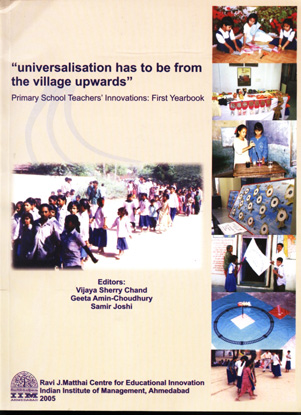
The
First Yearbook of
innovations by primary school
teachers is mainly addressed to teachers working in state run and
funded schools operating in difficult environments. Titled
'Universalisation has to be from the village upwards', the yearbook
is the outcome of a project that is based on a practical
understanding of teacher development: build on the strengths that
exist within, build on the experiences of those who have performed
well, in spite of many constraints, using their own creativity and
resources.
The
practices of the 58
teachers that
have been reported in the book are responses to very context-specific
socio-economic and classroom situations. However, the constraints
faced by these teachers may be similar to those of a wide
cross-section of the primary school teaching community. These 58
teachers have been selected from a wider pool of innovative teachers,
whose work constitutes an 'educational bank', which can play the role
of a 'clearing house for educational innovations'
Rishi
Valley Insitute for Education Resources (RIVER)
RIVER
has developed a unique structure for village education that consists
of a network of Satellite Schools where a community-based curriculum
is taught by village youth trained in especially designed multi-grade
methodologies. The academic curriculum is graded for individual
levels of learning, grounded in up-to-date information, and framed in
the local idiom and, finally, where the curriculum is integrated with
activities aimed to promote conservation, and sustain local culture.
The
education kit called 'School in a Box' consists of graded cards.
These cards represented a breaking down of the learning process into
smaller units. Groups of cards are then assembled into a set of
'milestones', which lead students from level I to level V in the
areas of language, mathematics and environmental science.
These
carefully designed 'study cards' and 'work cards' are supported by a
pictorial 'achievement ladder' that gives a clear sequential
organization to what are essentially self-learning materials.
Children
at different levels within a single classroom share the same kit. A
textbook in each subject for each child can be dispensed with or used
as enrichment material.
The
cards allow children to learn at their own pace by selecting, with
the help of the 'achievement ladder', the appropriate 'study card'
for their level and performing the necessary follow-up activities or
exercises contained in the 'work cards'. This method encourages
silent self-study and individualized learning, though teacher
instruction and group work are also a necessary part of the learning
process. It gave ample room to the fast-learner as well as the
slow-learner to progress at their own pace. Student absenteeism is
not a problem in our schools because a student is able to simply take
up where he or she had left off on returning to school after a period
of absence.
Learning
by rote and dry comprehension exercises are abandoned in favour of
activity-based learning. Work cards supported by teaching aids are
prepared in such a way that children are actively involved in what
she is doing and the possibility of her sitting "dreaming"
in front of an open book is reduced to the minimum. -yaprao@rishivalley.org
SAHMET
Sahmet
has been working in Madhya Pradesh since 1992. Initially, its efforts
were directed at re-introducing organic farming to the small and
marginalised farmers in the region. Its focus on making the tribals
conscious of the political process in order to empower then, was not
having any impact on their daily lives. SEHMAT therefore felt that
tribals could become part of mainstream society only by acquiring
education. And decided to focus on giving the tribal child an
opportunity to get good quality education.
In
1997, Sahmet initiated its efforts to improve rural school education
in 40 villages of Hoshangabad district, by involving the youth in
educational activities, providing library services, and encouraging
community interface and supplementary teaching. These initiatives
have resulted in an increase in enrollment rates and a reduction in
the number of drop-outs in government schools. The Sahmet project
operates through local, mostly tribal, young people who are trained
on the job and encouraged to think of themselves as agents of change
in their own communities.
SeHaT
SeHAT
(School Health Action And Training) is an approach to school health
promotion, which is curriculum integrated, child centered and
activity based. SeHAT is working in partnership with local government
like Municipal Corporation etc.
Initial
pilot programme was run, selecting low-income schools for four years,
developing methods and materials for incorporating health topics into
the curriculum. These include communicable diseases, sanitation,
nutrition, personal hygiene, tobacco, safety, pollution. The project
has developed activity based lesson content, enjoyable learning,
model of delivery, awareness of play way methods to develop awareness
of healthy habits.
Teaching
methods have been reoriented from didactic to child-centred
approaches. The programme includes teacher training in use of health
education materials.
No.
of Schools: Initially 450, now expanded to 750 schools in Dehli and
100 in Bombay
SUTRADAAR
Bangalore-based
Sutradhar as a resource centre for children's teaching aids, seeks to
promote creative education. Sutradhar goes further that most
grassroots organisations who developing sets of textbooks and other
materials for children, by bringing the spectrum of all these
materials under one roof and making them available in the regular
marketplace. Thus, they not only providing an impetus to folk toy
makers, but alsowe are also providing a service to manufacturers and
non-profit organisations who are developing teaching aids by
providing for the end users— parents and educators," Mandira
explains. Thus, there is a wide range of (indigenously made) toys
available, attractively displayed on easy to access shelves and
arranged according to age ranges and skills. Besides that, Sutradhar
also offers a variety of low-cost books, teaching aids as well as
story books.
Sutradar
isworking towards having a permanent open access centre for children.
"Such centres already exist for womens' studies, health and
environment issues. But for children and education, there are no such
accesses where one can go for material and information." -
Educating The Imagination, Sushama Nagarkar, Humanscape,
01/11/1996, [C.ELDOC.N00.01nov96HUS3.pdf
]
SHIKSHANTAR:
The
Peoples’ Institute for Rethinking Education and Development
Shikshantar,
a not-for-profit
movement, was founded to challenge the culture of schooling and
institutions of thought-control. Today, factory-schooling and
literacy are suppressing many diverse forms of human learning and
expression, as well as much-needed organic processes towards just and
harmonious societal regeneration.
Shikshantar
is
committed to creating spaces where individuals and communities can
together engage in dialogues to:
- generate
meaningful
critiques to expose and dismantle/ transform existing models of
Education and Development,
- reclaim
control over
their own learning processes and learning ecologies, and
- elaborate
(and
continually re-elaborate) their own complex shared visions and
practices of Swaraj.
Shikshantar is based in
Udaipur
(Rajasthan, India).
Suvidhya
Suvidya
is a Teacher Resource / Learning Centre in south Bangalore working
with approximately 50 teachers from ten schools in the city. Some of
the key activities being undertaken include: (a) needs analysis
through a participatory process of dialogue with teachers and school
administration; (b) series of teacher training workshops in areas
identified through needs analysis; and (c) development of
teaching-learning material.
Timbaktu
-
Timbaktu
Education
Programme called
Chiguru runs three day schools, one evening school and one
residential school.The facilities available to the C K Palli schools
schools, have been developed into a resource center for children from
other schools from this and nearby villages.
Though Chiguru does
not
exactly
follow the official syllabus, the goal of the schools is to
reintegrate the children into government schools. The children attend
the 5th, 7th and 10th standard government examinations and so far
have fared very well in them. Many students have been able to rejoin
regular schools and have done exceedingly well. The school, inspired
by several external sources, developed its own methodology in
teaching, math, science, social studies, telugu, hindi, and English.
Students are encouraged to ask questions and teachers are willing to
explain carefully until everyone understands. The goal is that the
children enjoy learning and become interested in the different
subjects. Motivated students learn quicker and better than those
under pressure do. Today there are worksheets for each class and
subject available and the teachers are experienced in teaching
according to the principles of alternative education. Most of the
children are eager to study and are very curious about the world and
their environment. Prakruthi Badi as the central school, has now a
comprehensive library and well equipped environmental science lab for
the older students.
In the afternoon
classes the
children
acquire skills in woolen embroidery, tailoring, embroidery, bag
making, drawing, clay work, gardening, music, folk dance etc. The
teachers have become good resources persons in some of these skills.
The teachers taught most of the skills.
Skill training is
given a
lot of
importance because the children enjoy them and by getting orientation
in a variety of skills, they explore their potential and improve
their creativity. Some activities give opportunities to children to
see various academic concepts in a different context. A practical
benefit that is foreseen is that for some children the skills they
learn at school may become sources of livelihood in future. There is
also a potential for earning while learning, which has already
started on a small scale.
In the residential school, each child
works on an organic vegetable plot, and documents the process and
produce. The children also have a chicken coup, and breed country
foul. The produce is used in the school kitchen, and payment is
made into the child’s account, which is in turn used for special
outings, educational tours etc. Thus besides learning the skills,
they learn respect for land based activity, as well as learn to value
their work.
The Children in Chiguru schools
spend a lot of time singing, dancing and playing.. A lot of emphasis
is placed on the traditional folk songs and dances of the local area.
Vidyankura
- the District Quality Education Programme (DQEP)
Vidyankura is a project to enhance the quality of
elementary education undertaken by National Institute of Advanced
Studies, Bangalore, in collaboration with the Karnataka Sarva Shikash
Abhiyan.
The project is premised on ideas that ‘quality’ in
elementary education must include:
- teaching
practices that cater to children’s
cognitive and social developmental needs
- schools that have
a vibrant and responsive
relationship with members of the community
- learning which
integrates local knowledge with
textual knowledge to provide children with a comprehensive set of
skills and knowledge.
The programmes are::
1. SCHOOL-COMMUNITY CONTACT PROGRAMME focuses on the
need to integrate members of the community and parents into the
functioning and orientation of the school and to introduction of new
methods to enhance learning. A handbook for parents has been
developed to help them to understand issues related to the
functioning of schools, ways to contribute towards them and to
support their children’s learning levels.
2. STRENGTHENING RESSOURCE CENTRES of SSA at the
CLUSTER
and BLOCK levels through a one year capacity building certificate
course and regular trainings to develop perspectives, knowledge and
work related skills and field based follow ups. Strengthening of the
resources of the Cluster Resource Centre is also envisaged.
The faculty at the Block level is trained in technical
and academic development and planning. Further a library and
resource centers of resources for curriculum materials is also being
upgraded.
3. MULTIGRADE LANGUAGE CURRICULUM DEVELOPMENT :
focuses
on the Tribal Schools of the district. By development of a reading
test, classroom observations and textbook analysis.
4. POSTGRADUATE PROGRAMME to develop a cadre of
well-trained education professionals.
5. MATERIAL DEVELOPMENT, DOCUMENTATION for teachers,
teacher educators, parents and children in order to support the new
learning programmes in Kannada as well as case studies and handbooks
for trainers, teachers and teacher - educators are being developed.
6. COLLABORATION AND ADVOCACY to reach a wider
audience
through joint workshops, lectures and consultations. ( taken from http://www.iisc.ernet.in/nias/site/vidya.htm
)
VIGYAN
Ashram
The
Vigyan Ashram at Pabal was started 25 years ago by Dr Kalbag. It aims
to provide multi-skill training in technologies among school
children.The philosophy is that doing things with ones hands helps
improve ones capacity to learn, thus the intellectual and physical
pursuits are brought together. It also gives confidence to learn new
skills as well as to face real life situations.
The
course at the Ashram is a year long one with introduction to varied
skills in the following areas: Engineering [plumbing/ welding,
masonry etc.], animal husbandry and agriculture, food preservation,
health, energy and environment [maintenance of various gadgets, motor
winding and repair, fabrication of bio-gas plants / solar water
heater etc.]
The
emphasis is on doing real life projects, with proper costing done and
the students labour charged for. It is a requirement of the project
that each student earns at least Rs 1000 by the end of the course!
This means that work is done with a lot of seriousness and every
class session is challenging and intensely engaging for the student.
The
programme has been running successfully for the past 25 years. That
it still continues with a lively spirit and enthuses so many students
to come and learn is a testament to the sound base on which the whole
idea rests and the the way the course is conducted. The Maharashtra
Govt is now trying to replicate the course for school students in
rural areas-
http://newsfromthulir.blogspot.com/2006_01_01_newsfromthulir_archive.html
Viswa
Bharathi Vidyodaya Trust (VBVT).
VBVT
covers schools in 303 villages of Gudalur and Pandalor blocks in
Gudalur district, Tamil Nadu. VBVT is also setting up Area Education
Committees to interact with the parents on a regular basis through
community meetings at the village level, besides having tuition
centers and, village study centres, permanent libraries.
The
Vidyodaya Resource and Training Centre trains village education
workers, area coordinators, animators, village librarians and
government schools teachers, besides bringing out well illustrated
booklets in tribal languages based on the documentation of adivasi
stories, songs, riddles, etc. completed by ACCORD.
VBVT
is also focusing on vocational training in collaboration with local
agro-based industries like coffee / tea boards and tea factories.
VBVT is documenting and contacting institutions where vocational
training and placements can be organised, conducting series of
trainings for adolescent girls and boys, in collaboration with local
industries and government institutions / schemes like the community
polytechnic and finally, providing career counseling for high-school
students.
The
Vidyodaya School, managed by the tribals, is the base for providing
in-service training to teachers, development of teaching-learning
material and demonstration of quality education.
Conclusion
Karl
Polanyi, the great economic historian, pointed out,
'All
the functions that we would regard today as economic, were fulfilled
for social rather than economic reasons, mainly to satisfy kinship
obligations and to achieve social prestige.'
Today
even alternative schools are so organised that they require large
amount of money. Thus we have a situation where schools can run only
with hugh funding!
The
state originally took over from local communities, and which were
largely subsidised by the public so that they could be provided for
free for those in need. Now these functions are to be taken over by
unaccountable corporations who would charge the maximum price that they
could get away with - creating an unprecedented number of poor people
who would thus be deprived access to the basic requirements of life.
Will
NGOs also act like the Corporations? Private Education is already like
that. In what way are we different?
Surely
a more sustainable education system will rely of educational services
being provided as a social function, which involves "free"
or "love" services from each member of the community in
different forms, save for a few dedicated staff.
Notes
Systems Failure, An interview
with Anil Sadgopal, Times of India, 04/05/2004, [C.ELDOC.N20.04may04toi1.pdf]
Private schools for poor?, Sabith
Khan, Deccan Herald, 04/03/2004, [C.ELDOC.N21.04mar04dch2.html]
Improving the Quality of Government
Schools: by Mandira Kumar & Padma M Sarangapani. Sutraddhar.
Books for change.2005.[B.N30.M2]
[Digantar documents: "Theoretical
Basis of the Digantar Programme",: "Shiksha Kram"
(Curriculum)]
Seeds of Hope, Lokayan
SETHU
or BRIDGE”
A
Handbook for Parents of School-Going Children - Developed by the
District Quality Education Programme, National Institute of Advance
Studies (NIAS)