
Learnings
about
Improving Education
(Notes and References from documentation for NGOs and Teachers)
John D’Souza, Tanvi Patel and CED DocumentationTeam
Home

|
Learnings
about
Improving Education
(Notes and References from documentation for NGOs and Teachers) John D’Souza, Tanvi Patel and CED DocumentationTeam Home |
|
 |
Official
Programmes
to Improve Quality of Schools
|
 |
|
TRAWL
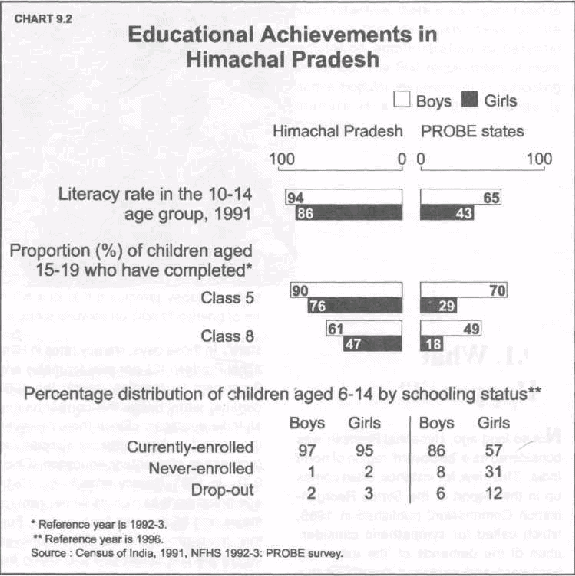
the Himachal countryside, and
a primary
school crops up every few kilometres, each one boasting not only
well-kept classrooms but also a healthy student-teacher ratio of 25:1,
or even lower, all for a handsome fee of Rs.2 a month. The education
department has also spiced up teaching by introducing co-curricular
activities, a la private schools.
|
District Primary Education Programme (DPEP)
The DPEP launched in November 1994 took a holistic view of primary education with emphasis on decentralised management, community mobilisation and district specific planning based on contextually and research based inputs.
In an articleviii reviewing the structure, functioning, impact and implications of the District Primary Education Programme (DPEP), in Karnataka, Padma M. Sarangapani and A. R. Vasavi observe that “Prior to 1990, there were a few large scale foreign funded projects in education. All of these were 'aid' programmes. In 1993, the Ministry of Human Resource Development (MHRD), Government of India (GOI), conceived the DPEP as an umbrella scheme under which support from all the different funding agencies would be channeled [MHRD, 1993]. Since 1990, the Government of India began accepting funding for elementary education in the form of loans, with the World Bank being the largest creditor. The European Union is also a large donor. From this perspective, the DPEP is a 'post-facto' programme, evolved to accommodate funds that were being made available; it was not a programme conceptualised by the government for which it subsequently sought to raise money.
The DPEP programme consists of a scheme spread over seven years to achieve the following:
The DPEP was able to renew interest and support for primary education. Coming after a decade long decline in the administration and management of primary education, the DPEP is widely perceived as having provided a boost to accessibility of schools in all settlements, and enabled an increased participation of disadvantaged communities. Following a pattern that has been noticed in all the DPEP phase I states, in Karnataka also there was a surge of interest in primary schoolteacher training, raising academic standards through introduction of new curricula (including encouraging textbooks using local stories and inputs by local persons), and renewing pedagogy.”
Along with the (DPEP) and the Nutrition Support to Primary Education (Midday Meal Programme) was planned to address the problem of equality, access retention and quality at primary stage. During the VIII Plan the enrollment of girls and children for SC and ST has shown an increase at the primary stage. The dropout rates have also shown a declining trend.ix
DPEP aimed to promote a child-centred form of education that was intended to bring out the total involvement of the child in the learning process. Shwetha E. Georgex depicts the atmosphere in one of the many government-aided schools in Kerala that underwent a curriculum revision under the DPEP.
“In a dilapidated building sporting the board 'Government High School' in Alwaye, a prominent town in Ernakulam District, a few Class One students are trying to learn the tables of seven by counting the seeds of the manjadi plant. A few others are reading aloud an adukkalapaattu and a bhakshanapattu (songs on kitchen vessels and food) from charts clipped to a rope tied across the classroom. No text-books and no scribbling down meaningless information. The noise is deafening, the scene pure chaos. The kids have never enjoyed learning better-says their teacher, but an official order to cease this kind of teaching could come any day now. This school is one of the many government-aided schools in Kerala that has undergone a curriculum revision under the DPEP introduced by the Left government in the early nineties. ...Text books were changed. Written content was minimized. Drawing, colouring, group activities, field trips and reading comers in classrooms were the new curriculum. Teachers were trained in batches by expert groups. Monitoring agencies comprising of higher-grade teachers and Zilla officers toured schools to extend support and technical tips.”
“…But it
bombed. In
just the fourth year of its
implementation, the DPEP lost the complete faith of the public and
was labeled the greatest fiasco of the Left government. Parents began
complaining that their wards were not being given any written
homework. They could not fathom how composing a song on kitchen
vessels would help these kids pass the Tenth Board Exam. Anti-Left
parties maintained that 'alternative education methods' are brainless
schemes funded by the World Bank to keep backward countries more
backward. It was an excellent scheme. But it was implemented without
any proper planning.”
Alternative Schooling, Non Formal Education (NFE)
The system of Non-formal Education (NFE) was conceived in 1978 to meet the requirements of those children who were unable to attend formal schools. The process was meant to be part of a micro- planning strategy, to reach out to every family and every child, and involve them in the process of education. An Alternative School (AS) has a delivery mechanism distinct from formal schools and NFE. It has been conceived as transacting the same curriculum and textual material as in the formal system but outside the structure. The Open School and Shiksha Karmi schools are examples of AS.
Although non-formal education was seen as one way to meet the needs of children who are unable to go to formal schools the concept did not take off.
According to Shushmita Duttxi, today it is becoming increasingly clear that the Indian educational system requires more than just an expansion of the school system and an inclusion of the NFE system if it is to be set right.
“The ground realities have proved that without absolute commitment and large-scale human resource input, the very characteristics which should have made NFE attractive have worked against it — flexibility, localisation and need-specific strategies have often been used as loopholes to offer sub-standard education. It is also being accepted that without a parallel growth in economic activity and rise of other social development indicators, the true benefits of education will not reach the masses. Gradual disillusionment with the existing educational conditions has given rise to a concern that the very educational paradigm accepted by India may be unsuited to a large majority of its people. In an attempt to tailor the delivery system and content to the specific needs of various sections, there have been some small-scale experiments with educational structures, curricula, teaching strategies, teacher training, evaluation and certification, the teaching calendar and management.”
The Shiksha Karmi or volunteer teacher concept is some what like the barefoot doctor concept. The blueprint drawn up for the Shiksha Karmi Scheme is almost identical to the Gondi experiment of 1946 in Adilabad. It also has a parallel in the extremely successful strategy devised by Bunker Roy for night schools run by the Tilonia School of Social Work in Rajasthan for school dropouts and children of grazers and peasant families. Girls have a higher dropout rate than men. In Tilonia, school dropouts who have passed only the eight or 10th grade are employed as barefoot teachers. They are trained to generate social awareness towards the village environment and rural issues amongst the students by involving every possible resource in the village-policepersons, postmaster, nurse, patwari, bank manager, village head who explain how systems work (or do not work) for them.
The Rajasthan State Government implemented the Shiksha Karmi scheme in state schools in poverty-stricken areas where teacher absenteeism is rampant and village responses to the schools apathetic. These volunteers have low qualifications, and smaller salaries, but are highly motivated. They work in understaffed schools. In Madhya Pradesh, particularly in remote areas where there are no teachers, Shiksha Karmis substitute for them.xii
In an articlexiii published in Down-to-Earth, the then Education Secretary, National Capital Territory of Delhi, stressed the need for a review of India’s educational and training policy to educate tribals, the backward classes and the poor. “The Shiksha Karmi scheme has now completed a decade since its inception, covering about 2,000 village primary schools in over 70 blocks spread over 29 districts of Rajasthan. Taken both in terms of economy of investment as well as the spread of beneficiaries, this scheme is far more effective than residential schools would have been for the spread of primary education. While the Navodaya Vidyalayas have an annual student population of over one lakh students in the whole country, the Shiksha Karmi project benefits about 1,20,000 children in a single state.
Girls'
Education
Initiative in Uttar Pradesh
In 1999, in partnership with the government and other voluntary organisations, UNICEF initiated a project for girls' education in four blocks of Uttar Pradesh's Barabanki district, where female literacy was about 15 per cent. Alternative Learning Centres (ALCs) were established in villages that did not have a primary school within a one-kilometre radius, with the active participation of communities. Instructors were selected in co-operation with panchayats, and preference was given to local candidates. The number of ALCs increased from 50 in 1999 to 140 in 2001, when more than 4000 children were enrolled - a significant majority of them were out-of-school girls.
A one-year residential camp programme for girls was also introduced to provide learning opportunities for older out-of-school girls. This is now being replicated under Sarva Shiksha Abhiyan (SSA) across the state.xiv
The Government planned a major initiative to achieve UPE over the next seven years under the SSA scheme. The scheme envisaged community owned schools in which, all children between the ages of 6 and 14 years would be enrolled by the year 2003 to complete four to five years of schooling by the year 2007. A significant difference between this scheme and the previous attempts to push UPE is the idea of community-owned schools. This would make those who run the schools as well as the teachers directly responsible to the community they serve.xv
In the government's Sarva Shiksha Abhiyan (education for all), many places have no schools and many schools have no teachers. Most states have failed dismally to reach their teacher-appointment targets for 2003-04. Bihar's achievement was 0%. The achievement of teacher-appointment targets was just 21 % in West Bengal and 22% in UP. It was best in Orissa (79%) and Jharkand (69%) where appointments were decentralised to the panchayat or community level. In Bihar, power remains tightly centralised and that militates against flexible hiring. This drives home the need to decentralise education.
Some think India has too many civil servants. Yet, a World Bank study showed that India had one of the lowest number of civil servants per million of population. India's problem is an excess of bureaucrats in the wrong place and gross inadequacy where they are needed, as in education. The Pay Commission award raised salaries and made most state governments bankrupt. Consequently, the latter virtually froze fresh recruitment.
Many opted for para teachers appointed by panchayats rather than regulars. The ostensible reason was to increase accountability and reduce teacher absenteeism, but a more compelling reason was bankruptcy. Para-teachers are not state government employees, and so can be paid a tiny fraction of government teachers' salaries. True, they cannot provide high-quality education, yet some education is better than none. But as long as they are appointed by state governments, they can always claim and get parity with regular teachers. Ideally panchayats and communities should have the authority and funds to hire, pay and fire teachers. That alone will ensure accountability to the community and end the current scandalous state of education where teacher absenteeism can be as high as 40 %. They must be appointed by panchayats, not state governments.xvi
Fudged statistics, rather than effective policy, is now the chief weapon to substantiate India’s capacity to meet the Dakar Goal of UPE by 2015. The Dakar Goal is a dilution of India’s policy commitment to elementary education of eight years. Interestingly, the SSA boasts of universalising primary education by 2007 and upper primary education by 2010. However, last year’s UNESCO’s report had placed India in a category that is at “serious risk of not achieving any of the three Dakar Goals” even by 2015. These goals included universal primary education, adult literacy and gender parity at the primary stage. The only other two South Asian countries in this embarrassing category with India are Nepal and Pakistan. Even Bangladesh and Bhutan are ahead of us.xvii
vi Public Report on Basic Education in India (PROBE), 1999, [R.N21.604]
vii Adding joy to learning, Bharathi Prabhu, Deccan Herald, 30/03/2003, [C.ELDOC.N21.30mar03dh6.htm]
viii
Aided Programmes or Guided Policies? DPEP in Karnataka,
Padma M
Sarangapani, A R Vasavi, Economic & Political Weekly, 09/08/2003,
[J.ELDOC.N00.09aug03EPW2.pdf]
x Off the beaten track, Shwetha E George, Humanscape, [J.ELDOC.N00.01jan02HuS2.pdf]
xii Adapted from the PROBE Report,[R.N21.604]
xiii Educating the underprivileged, Grassroot Development, 31/08/1998, [C.ELDOC.N00.31aug98grd1.pdf]
xiv Mapping India’s Children, UNICEF in Action, [R.L22.641]
xv
Plan for Universal Primary
Education,
The Hindu, 17/11/2000, [C.ELDOC.N21.17nov00h1.pdf]
xvi Teachers day out, Give Panchayats Right To Hire & Fire, Economic Times, 30/06/2004, [J.ELDOC.N20.30june04et1.pdf]
xvii
Goal posts shifted, Anil Sadgopal, Hindustan Times, 11/11/2003,
[C.ELDOC.N21.11nov03ht1.html]
|
Table of contents | |